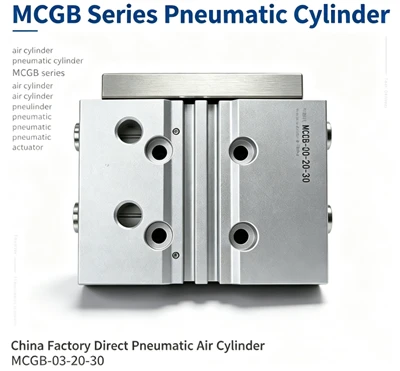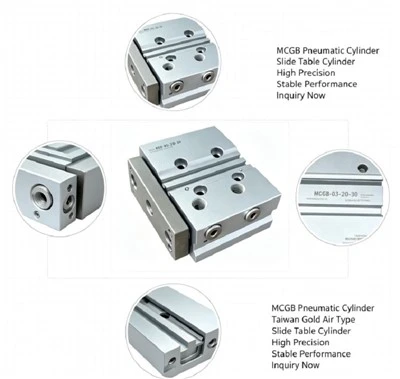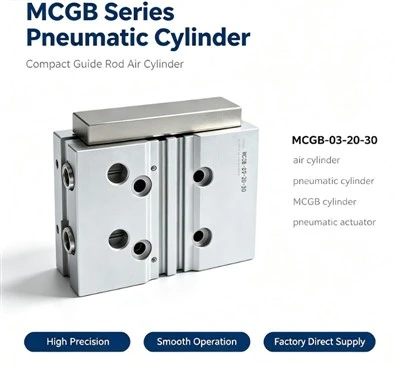
Internal structure diagram of the Pneumatic cylinder, detailed introduction of the Pneumatic cylinder structure composition
Pneumatic cylinders play a crucial role in assembly lines. So, how much do you know about Pneumatic cylinders?
Pneumatic actuators in pneumatic transmission convert the pressure energy of compressed gas into mechanical energy. Pneumatic cylinders can be classified into two types: those that perform reciprocating linear motion and those that perform reciprocating swinging. Pneumatic cylinders that perform reciprocating linear motion can be further divided into four types: single-acting, double-acting, diaphragm, and impact Pneumatic cylinders.
Internal structure diagram of the Pneumatic cylinder
The Pneumatic cylinder is composed of the Pneumatic cylinder barrel, end cover, piston, piston rod and sealing parts. Its internal structure is shown in the figure:
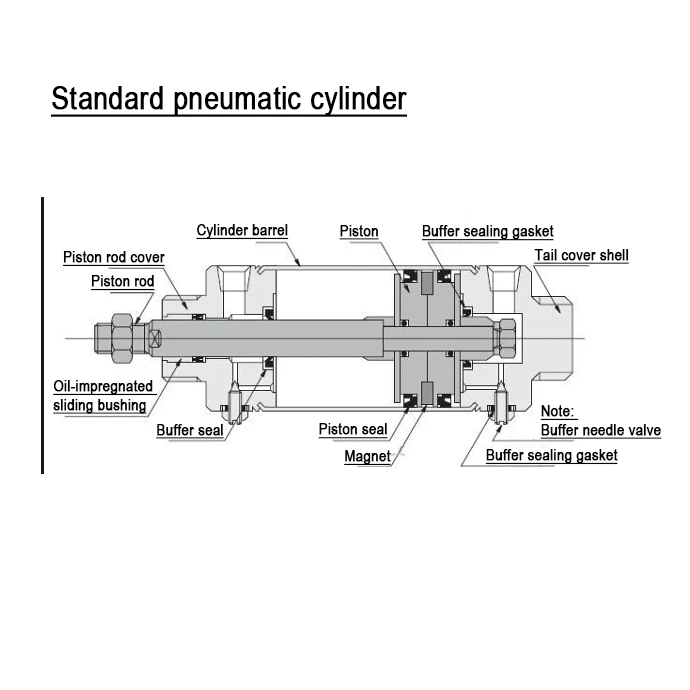
Detailed introduction to the structure and composition of the Pneumatic cylinder
1) Pneumatic cylinder barrel
The inner diameter of the Pneumatic cylinder barrel represents the magnitude of the output force of the Pneumatic cylinder. The piston should slide back and forth smoothly in the Pneumatic cylinder barrel, and the surface roughness of the inner surface of the Pneumatic cylinder barrel should reach Ra0.8 μ m. For the steel pipe Pneumatic cylinder barrel, the inner surface should also be plated with hard chromium to reduce frictional resistance and wear, and to prevent rust. The material of the Pneumatic cylinder barrel is not only high-strength carbon steel pipe, but also high-strength aluminum alloy and brass. Small Pneumatic cylinders are made of stainless steel tubes. For Pneumatic cylinders with magnetic switches or those used in corrosion-resistant environments, the Pneumatic cylinder barrels should be made of materials such as stainless steel, aluminum alloy or brass. A combined sealing ring is used on the Pneumatic cylinder piston to achieve bidirectional sealing. The piston and the piston rod are connected by rivets without nuts.
2) End cover
The end cover is equipped with intake and exhaust ports, and some also have a buffer mechanism inside the end cover. The side end cover of the rod is equipped with a sealing ring and a dust-proof ring to prevent air leakage from the piston rod and to prevent external dust from entering the Pneumatic cylinder. A guide sleeve is provided on the side end cover of the rod to improve the guiding accuracy of the Pneumatic cylinder, bear a small amount of lateral load on the piston rod, reduce the downward bend when the piston rod extends, and extend the service life of the Pneumatic cylinder. Guide sleeves are usually made of sintered oil-impregnated alloys or forward-inclined copper castings. In the past, the end covers were commonly made of malleable cast iron. Now, to reduce weight and prevent rust, aluminum alloy die-casting is often used. Some micro Pneumatic cylinders are made of brass.
3) Piston
The piston is the pressure-bearing part in the Pneumatic cylinder. To prevent gas leakage between the left and right chambers of the piston, a piston sealing ring is provided. The wear-resistant rings on the piston can enhance the guidance of the Pneumatic cylinder, reduce the wear of the piston sealing ring, and decrease the frictional resistance. Wear-resistant rings are made of materials such as polyurethane, polytetrafluoroethylene, and fabric-reinforced synthetic resin. The width of the piston is determined by the size of the sealing ring and the necessary length of the sliding part. The sliding part is too short, which can easily cause early wear and jamming. The materials commonly used for pistons are aluminum alloy and cast iron. For small Pneumatic cylinders, the pistons are made of brass.
4) Piston rod
The piston rod is the most important force-bearing part in the Pneumatic cylinder. Usually, high-carbon steel is used, with its surface treated by hard chromium plating, or stainless steel is used to prevent corrosion and enhance the wear resistance of the sealing ring.
5) Sealing ring
The sealing of components in rotary or reciprocating motion is called dynamic sealing, and the sealing of stationary parts is called static sealing. The connection methods between the Pneumatic cylinder barrel and the end cover mainly include the following types: integral type, riveted type, threaded connection type, flange type, and pull rod type.
6) When the Pneumatic cylinder is in operation, it relies on the oil mist in the compressed air to lubricate the piston. There are also a small number of self-lubricating Pneumatic cylinders.
Above is Internal structure diagram of the Pneumatic cylinder, detailed introduction of the Pneumatic cylinder structure composition content, to learn more related information are available at https://www.joosungauto.com/.