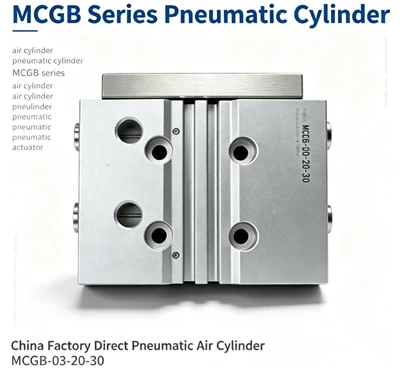
A variety of types and selection guide for pneumatic actuators - Pneumatic Cylinders
Diverse types of Pneumatic Cylinders
1.1 Linear type Pneumatic Cylinders
Linear Pneumatic Cylinders include standard Pneumatic Cylinders, thin Pneumatic Cylinders and pen-shaped Pneumatic Cylinders. These Pneumatic Cylinder types have extensive applications in the industrial field. According to different demands and occasions, the appropriate Pneumatic Cylinder type can be selected.

Clamping Pneumatic Cylinder: It features locking and gas cut-off protection functions to ensure safety and reliability.
Pneumatic Cylinder positioning: The Pneumatic Cylinder itself does not have a multi-point positioning function, but special requirements can be achieved through a double-stroke design.
Double-axis Pneumatic Cylinder: Its output force is twice that of the single-axis Pneumatic Cylinder, and it also has the ability to withstand a certain bending moment.
The positioning accuracy of the Pneumatic Cylinder is limited by the limit device. Therefore, when using large output force and high speed, limit devices must be installed to prevent excessive impact on the piston and damage to the Pneumatic Cylinder head. For small-piston and short-stroke Pneumatic Cylinders, in the absence of heavy loads, no guiding or load-bearing structures are required. The three-axis Pneumatic Cylinder, on the other hand, is equipped with guide rods, providing better guiding performance.

Measures to prevent the Pneumatic Cylinder from rotating: Adopt an irregular cross-section design and be equipped with guide rods to ensure stability and safety.
1.2 Rotary Pneumatic Cylinder
Stability is a key issue in the application of rotary Pneumatic Cylinders. To ensure its stable rotation and prevent self-rotation, a series of measures need to be adopted. Among them, the design of irregular cross-sections and the installation of guide rods are important technical means. They work together to provide a strong guarantee for the safe operation of the rotary Pneumatic Cylinder.

1.3 Function Types: Gripper Pneumatic Cylinder, finger Pneumatic Cylinder, and blocking Pneumatic Cylinder
In the application of Pneumatic Cylinders, apart from rotary Pneumatic Cylinders, there are also different types of choices such as gripper Pneumatic Cylinders, finger Pneumatic Cylinders and blocking Pneumatic Cylinders. These Pneumatic Cylinders are designed according to their specific functions to meet different industrial demands and provide diverse solutions for automated production.
2. Theoretical output force of the Pneumatic Cylinder
The theoretical thrust (N) calculation formula for a common double-acting Pneumatic Cylinder is:
In the formula, D represents the Pneumatic Cylinder diameter of the Pneumatic Cylinder, measured in millimeters (mm), while p indicates the working pressure of the Pneumatic Cylinder, measured in megapascals (MPa). Based on these parameters, we can calculate the theoretical thrust of the Pneumatic Cylinder. Meanwhile, the theoretical tensile force can also be calculated through a similar formula.
During the calculation process, if the diameter of the piston rod d (in millimeters) is known, d can be approximately set as 30% of the Pneumatic Cylinder diameter D, that is, d=0.3D, for relevant estimation.
3. Load rate of the Pneumatic Cylinder
The load rate of the Pneumatic Cylinder, that is, the ratio of the actual load force F to the theoretical output force F0, is an important indicator for evaluating the performance of the Pneumatic Cylinder. In practical applications, the load condition will directly affect the actual load force acting on the piston shaft, so the selection of the load rate is of vital importance. By determining the load rate η, we can further calculate the theoretical output force of the Pneumatic Cylinder. It is worth noting that the selection of the load rate η is closely related to the load performance and movement speed of the Pneumatic Cylinder (for details, see the table below).
4. Selection of Pneumatic Cylinders
On the basis of meeting the work requirements and conditions, we need to correctly select the type of Pneumatic Cylinder according to the actual situation. When making a selection, it is necessary to consider whether there will be an impact phenomenon and impact noise when the Pneumatic Cylinder reaches the end of the stroke to avoid choosing a buffer Pneumatic Cylinder. At the same time, we should also pay attention to the weight of the Pneumatic Cylinder, and a light-duty Pneumatic Cylinder is preferred. For situations where installation space is limited and the stroke is short, thin Pneumatic Cylinders would be a more suitable choice. In addition, if there is a lateral load, a Pneumatic Cylinder with a guide rod will be more suitable. If high braking accuracy is required, locking the Pneumatic Cylinder is indispensable. In addition, in situations where the piston rod is not allowed to rotate, a Pneumatic Cylinder with a non-rotating rod function can be selected. In high-temperature environments, we need to choose heat-resistant Pneumatic Cylinders. In corrosive environments, corrosion-resistant Pneumatic Cylinders are the first choice. Meanwhile, to prevent the influence of harsh environments such as dust, a dust cover should be installed at the extended end of the piston rod. In addition, if no pollution is required, then oil-free or oil-free lubricated Pneumatic Cylinders will be a suitable choice.
After selecting the Pneumatic Cylinder, we also need to determine the diameter of the Pneumatic Cylinder based on the load, the air pressure used and the direction of action. When selecting the Pneumatic Cylinder stroke, factors such as the movement distance of the workpiece, the application scenario and the stroke of the mechanism should be taken into consideration. However, it is generally not recommended to select the full stroke to prevent the piston from colliding with the Pneumatic Cylinder head. For special occasions such as clamping mechanisms, a margin of 10 to 20 mm should be added according to the calculated required stroke. Next, we need to select the Pneumatic Cylinder series and installation type. Different series of Pneumatic Cylinders have different installation methods, including basic type, foot type, flange type, U-hook type and shaft ear type, etc. In addition, the type of buffer also needs to be selected, such as no buffer, rubber buffer, air buffer or hydraulic shock absorber, etc. Meanwhile, for position detection, we also need to select the magnetic induction switch and ensure that the Pneumatic Cylinder is equipped with a magnetic ring inside. Finally, don't forget to select the Pneumatic Cylinder parts, including related joints, etc.
Above is A variety of types and selection guide for pneumatic actuators - Pneumatic Cylinders content, to learn more related information are available at https://www.joosungauto.com/.