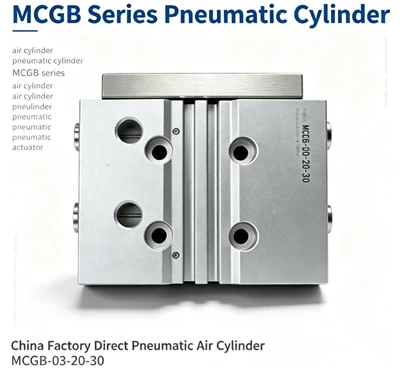
A **double-acting pneumatic cylinder** offers several advantages over a **single-acting pneumatic cylinder** due to its ability to operate in both directions using compressed air. Here are the key advantages of using a double-acting pneumatic cylinder:
### 1. **Bidirectional Operation**
- **Double-acting cylinders** can extend and retract the piston using air pressure in both directions. This makes them more versatile for applications that require movement in both directions, such as lifting, pushing, or pulling.
- **Single-acting cylinders**, on the other hand, only use air pressure for one stroke (usually the extension), with the return stroke typically relying on a spring or gravity.
### 2. **Greater Force Output**
- **Double-acting cylinders** can exert force in both the **extension** and **retraction** strokes because compressed air is applied to both sides of the piston. This allows them to provide more consistent and higher force, making them ideal for applications that require stronger or more consistent motion.
- **Single-acting cylinders** typically only provide force in one direction and rely on an external force (such as a spring) for retraction, resulting in lower overall force.
### 3. **Increased Control and Precision**
- Since double-acting cylinders are powered in both directions, they allow for **more precise control** of the motion in both the **forward** and **backward** strokes. This is especially important in applications that need exact positioning or speed regulation, such as in robotic arms or automated processes.
- **Single-acting cylinders** generally provide less control in the return stroke since the retraction is typically governed by a spring or other passive mechanism.
### 4. **No Need for External Return Mechanisms**
- A **double-acting cylinder** does not rely on springs, gravity, or external forces to return the piston to its original position. Instead, both strokes are powered by compressed air. This **eliminates the need for additional components** like springs or weights that are needed in single-acting cylinders.
- **Single-acting cylinders** require an external return mechanism (typically a spring) to bring the piston back after the extension stroke. This can limit their range of use and increase mechanical complexity.
### 5. **Faster Cycle Times**
- Double-acting cylinders can achieve **faster cycle times** because both strokes are powered by compressed air, making them ideal for high-speed applications. This allows for quicker extension and retraction, improving the efficiency of processes that require frequent or continuous motion.
- **Single-acting cylinders** tend to be slower, especially when the return stroke relies on a spring that may not provide uniform speed or force.
### 6. **Higher Efficiency in Repetitive Operations**
- **Double-acting cylinders** are well-suited for **repetitive operations** like material handling, assembly line work, and automation systems because they provide consistent and reliable motion in both directions without needing additional components or mechanisms for retraction.
- **Single-acting cylinders** can be inefficient in these scenarios because the return stroke may not be as consistent or as easily controlled, leading to less reliable performance over time.
### 7. **Better for Heavy Loads**
- Because double-acting cylinders provide more consistent and controlled force in both directions, they are better equipped for handling **heavier loads** in both extension and retraction strokes. The air pressure in both chambers allows the cylinder to perform more demanding tasks, such as pushing or pulling heavy objects or machinery.
- **Single-acting cylinders** may struggle with heavy loads, especially during the return stroke, as the retraction force is typically weaker and less controlled.
### 8. **Compact Design with More Functionality**
- Double-acting cylinders offer **greater functionality** in a **compact design**. They can perform both the pushing and pulling actions with a single cylinder, whereas single-acting cylinders require additional components to achieve the return stroke, potentially increasing the system's overall size and complexity.
- **Single-acting cylinders** are limited in their functionality since they cannot operate in both directions without additional mechanisms.
### 9. **Reduced Maintenance**
- **Double-acting cylinders** generally require **less maintenance** than single-acting cylinders, as they don't rely on springs or other mechanical components for retraction. This reduces the wear and tear on these components, leading to fewer maintenance requirements and a longer lifespan.
- **Single-acting cylinders**, with their springs or gravity-based return mechanisms, may require more frequent maintenance or replacement of springs, adding to the overall cost of ownership.
### 10. **More Versatile Applications**
- Due to their ability to provide force in both directions and the control offered in both strokes, **double-acting cylinders** are much more versatile in a wider range of applications. They are commonly used in industries like **automotive manufacturing**, **material handling**, **robotics**, **packaging**, and **construction** for both pushing and pulling tasks.
- **Single-acting cylinders** are typically used in simpler applications where only one directional motion is needed, such as clamping or lifting applications, making them less versatile.
### Conclusion:
Overall, **double-acting pneumatic cylinders** offer enhanced versatility, efficiency, and control compared to **single-acting cylinders**. They are capable of handling more demanding tasks, providing precise control, faster cycle times, and higher force output in both directions. While single-acting cylinders may be sufficient for simpler applications, double-acting cylinders are the preferred choice for more complex, high-performance, and high-speed operations.