

Solenoid valves are classified according to their normal state, operation type, and circuit function. All of these must be specified when choosing a new solenoid valve and integrating it into an existing system. Like any other type of automatic start valve, solenoid valves are usually classified according to their normal (power-off) state. This feature also indicates its fail-safe location. When power is cut off, the spring inside the solenoid valve returns the plunger to its normal position.
1. Normally open solenoid valve
The normally open solenoid valve opens when the power is off. Activate the solenoid valve to close the valve. This is very useful in applications where air or gas flow must be maintained in the system during a power failure.
2. Normally closed solenoid valve
In contrast to a normally open solenoid valve, a normally closed one means it is blocked when it is not powered. The valve is opened by sending electricity through the solenoid valve. Normally closed solenoid valves are more common than normally open ones. Most applications require the shutdown or isolation of system pipelines during system failures.
3. Bistable solenoid valve
Normally open and normally closed solenoid valves are regarded as monostable valves. On the other hand, bistable solenoid valves have a second solenoid valve instead of a spring return mechanism. They don't have normal positions. When starting up, they remain in the same position even if there is a power outage.
Another classification of solenoid valves is the type of operation. They can be activated through two main methods. The first type is direct action, which is completely dependent on the electromagnetic force generated by the solenoid. The next step is to use the pressure provided by the pilot pipeline through an indirect method. These methods can also be combined to create a valve activated by electromagnetic force and pipeline pressure.
4. Direct-acting solenoid valve
For this type of solenoid valve, the static pressure increases with the increase in the orifice size. The increase in static pressure requires a stronger action of the solenoid valve. Therefore, the magnetic field is stronger. This means that for a certain amount of pneumatic pressure, a larger flow rate requires a larger solenoid. Then the pressure and flow rate are proportional to the required solenoid size. This type of solenoid valve is typically used in applications with small flow rates and working pressures.
5. Internal pilot solenoid valve
For high-flow and high-pressure applications, internal pilot solenoid valves are used. In this type of valve, the valve is opened or closed by the pressure of the fluid. To achieve this, a hole opening or a balance hole was installed. The usual design involves the core blocking flow on the orifice. When the valve is closed, air passes through the orifice and pressure is formed on both sides of the diaphragm. As long as the airflow is blocked, a closing force will be generated due to the large effective area at the top of the diaphragm. When the valve is opened, the valve core will open the orifice, thereby releasing the pressure at the top of the diaphragm. Then the pipeline pressure opens the valve.
6. External pilot solenoid valve
This type of valve adopts the same concept as the internal pilot valve, but the pressure used to drive the valve comes from the air supplied externally. A separate air circuit is integrated into the valve through an additional port. Both internal and external pilot solenoid valves are called indirect or servo-assisted valves, and their main driving force comes from the pressure difference between the upstream and downstream pipelines of the valve.
7. Semi-direct-acting solenoid valve
Semi-direct action combines the principles of direct and indirect action valves. In addition to the magnetic force from the solenoid, the pressure difference at both ends of the valve helps to open or close the valve. When the plunger is activated, the diaphragm is lifted to open the valve. At the same time, one hole opening causes the pressure at the top of the diaphragm to be released. Closing this hole through a plunger will generate greater pressure at the top of the diaphragm, thereby closing the valve. Finally, solenoid valves are also classified according to their circuit functions. They can serve as a simple isolation valve, providing services for a single flow path. Other applications require multiple flows. One example is a cylinder that requires pressurized and exhaust flow paths.
8. Two-way solenoid valve (2/2 way valve) :
These types of solenoid valves have an upstream port and a downstream port. They are the most basic types, used to block or allow air flow. Two-way solenoid valves are available in two configurations: normally open and normally closed.
9. Three-way solenoid valve (3/2-way valve) :
The three-way solenoid valve has three ports: inlet (pressure port), exhaust and outlet (actuator port). They have two states. These two states alternately apply and discharge pressure from the actuator or downstream equipment.
The three-way solenoid valve can also be configured as normally open and normally closed, adding a universal function. For a normally open three-way valve, when the valve is de-energized, air flows from the air inlet to the air outlet, and the exhaust port is closed. When powered on, the air inlet is closed and the air outlet is connected to the exhaust port. The situation of normally closed valves is just the opposite. On the other hand, the general function is used to select the flow commutation from one port to another.
10. Four-way solenoid valve (4/2-way valve) :
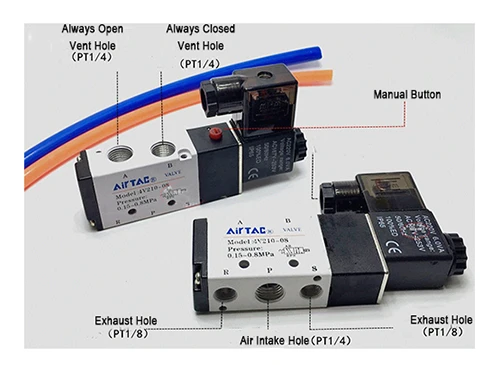
The four-way solenoid valve has four ports: one inlet (pressure port), two outlet or actuator ports, and one exhaust port. The two states of this valve allow pressure to flow from the pressure port to one of the outlet ports, while discharging pressure from the other port to the exhaust port. There are no normally open or normally closed positions. They mainly serve as directional control valves.
11. Five-way solenoid valve (5/2-way valve)
The five-way solenoid valve is similar to the four-way valve, except that it has an additional second exhaust port. They also act as directional control valves, allowing flow on one pipeline while venting on the other. Each pipeline has an independent exhaust port. Due to the possible different exhaust speeds of the two lines, the five-way solenoid valve is superior to the four-way solenoid valve. When used in a double-acting cylinder, the retraction (or extension) speed of the cylinder can be faster than the extension speed.
12. Five-way solenoid valve with middle position (5/3-way valve) :
These types of solenoid valves are similar to ordinary 5/2-way valves, but they have an additional center position under normal conditions. They have two solenoids and two spring return mechanisms to allow the actuator to return. Different types of 5/3-way valves are classified according to their functions under normal conditions. Generally, the normal state is the "stationary" state of the valve that keeps the actuator in position.
Above is Types of pneumatic solenoid valves and their functions content, to learn more related information are available at https://www.joosungauto.com/.


