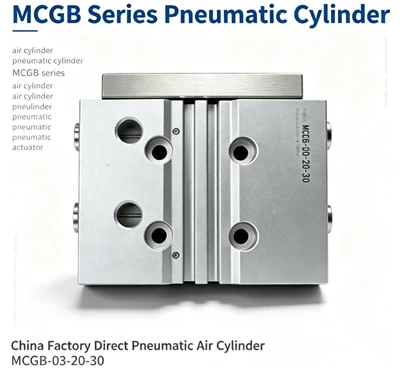
Pneumatic actuator - Pneumatic cylinder
Types of cylinders
1.1 Straight Line Classes
Standard cylinders, thin cylinders, pen-shaped cylinders
Clamping cylinder: With lock, air cut-off lock, and anti-air cut-off protection
Cylinder positioning: The cylinder itself does not support multi-point positioning or double stroke
Double-axis cylinder: Double output force, capable of withstanding certain bending moments.
The positioning accuracy of the cylinder depends on the limit. When using it with a large output force or high speed, a limit must be added. The reason is to prevent the piston from excessive impact and easily damaging the cylinder head. Small pistons, short-stroke cylinders, rely on their own hard steel
Guide structure: Single-axis cylinders generally should not be directly loaded and need to be equipped with guide/load-bearing structures (guide shafts, linear bearings, linear guides). Small pistons, short-stroke cylinders, when not carrying large loads, and without guiding/load-bearing structures, are also acceptable. The three-axis cylinder has the characteristics of a guide rod
Anti-self-rotation measures: Irregular cross-section, with guide rods
1.2 Rotary type: Rotary cylinder
1.3 Functional categories: Gripper cylinders/, blocking cylinders


2. Theoretical output force of the cylinder
The theoretical thrust (N) of a common double-acting cylinder is: Fa=0.25π*D^2*P
In the formula:
Cylinder diameter (mm
The working pressure (MPa) of cylinder p.
The theoretical tensile force (N) is: Fa=0.25π*(D-d)^2*P
In the formula, when d is the diameter of the piston rod (mm), it can be estimated that d=0.3D.
3. Load rate of the cylinder
The load rate of the cylinder: It refers to the ratio of the actual load force F of the cylinder to the theoretical output force F0.
Load capacity is an important factor in choosing a cylinder. The actual load force acting on the piston shaft varies with different load conditions.
The actual load of the cylinder is determined by the working conditions. If the load rate η is determined, the theoretical output of the cylinder can also be determined. The selection of the load rate η is related to the load performance of the cylinder and the movement speed of the cylinder.
4. Calculation of the output thrust and air consumption of the cylinder
Calculation of the output thrust of the cylinder. Taking the single-rod double-acting cylinder shown in Figure 10-14 as an example, the thrust F1 generated by the piston rod when the piston moves to the right and the pulling force F2 generated by the piston rod when it moves to the left can be calculated according to equations (10-2) and (10-3) :
(2) The air consumption q of compressed air for one reciprocating stroke of the cylinder can be calculated by equation (10-4) :
Since the working pressure required by each pneumatic device is different, there should be a unified pressure standard for calculating the air consumption. Generally, the flow rate of compressed air at different pressures is converted into the free air flow rate at standard atmospheric pressure for calculation, that is:
Q=q× (p+0.103) /0.103
In the formula: Q - free air consumption (m³/s) p - Working pressure of compressed air (Mpa)
5. Cylinder selection
According to the work requirements and conditions, correctly select the type of cylinder.
If there is no impact phenomenon or impact noise when the cylinder reaches the end of the stroke, a buffer cylinder should be selected. If light weight is required, a light-duty cylinder should be selected. If the installation space is narrow and the stroke is short, a thin cylinder can be selected. There is a lateral load, and a cylinder with a guide rod is optional. High braking accuracy is required, and a locking cylinder should be selected. The piston rod is not allowed to rotate. A cylinder with a non-rotating rod function can be selected. Heat-resistant cylinders should be selected in high-temperature environments. In corrosive environments, corrosion-resistant cylinders should be selected. In harsh environments with dust, dust covers need to be installed at the extended end of the piston rod. When pollution-free is required, oil-free or oil-free lubricated cylinders, etc. should be selected. The diameter of the selected cylinder is determined based on the relevant load, the air pressure used and the direction of action
Select the cylinder stroke and the workpiece movement distance:
It is related to the occasion of use and the stroke of the mechanism, but generally, the full stroke should not be selected to prevent the piston from colliding with the cylinder head. If it is used for clamping mechanisms, etc., an additional allowance of 10 to 20 mm should be added according to the calculated required stroke.
Select the cylinder series
Select the cylinder installation type
Different series have different installation methods, mainly including basic type, foot type, flange type, U-shaped hook, and shaft ear type
Select the buffers: no buffer, rubber buffer, air buffer, and hydraulic shock absorber
The selected magnetic induction switch is mainly used for position detection, and it is required that a magnetic ring be built into the cylinder
The selected cylinder parts include relevant joints
6. Commonly selected brands of cylinders: Airtac and SMC
Above is the Pneumatic actuator - cylinder content. To learn more related information, visit https://www.joosungauto.com/.