

I. The Core Function of Solenoid Valves
The solenoid valve, as a key component for electro-pneumatic conversion, shoulders the responsibility of efficiently converting electrical signals into pneumatic signals. After receiving the control instruction, the solenoid valve can precisely release, stop OR change the flow direction of the compressed air, thereby achieving multiple functions, including the control of the action direction of the pneumatic actuator component, ON/OFF switch quantity control, AND OR/NOT/AND logic control. Among the various types of solenoid valves, the electromagnetic control directional control valve holds a core position and plays a crucial role.
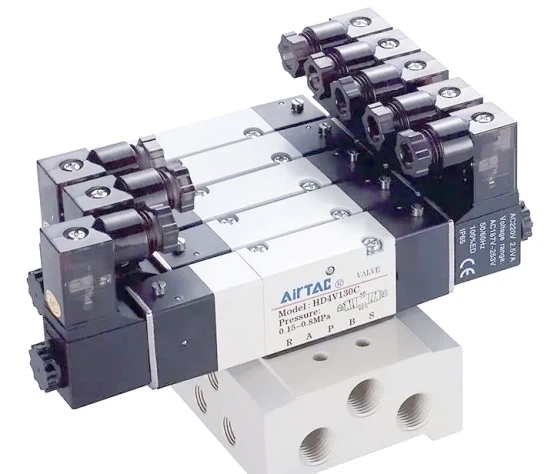
Ii. Working Principle of Electromagnetic Control Directional Control Valve
In pneumatic systems, the electromagnetic control directional control valve plays a crucial role. It is responsible for controlling the opening and closing of the air flow channel or changing the flow direction of compressed air. Its core working principle relies on the electromagnetic force generated by the electromagnetic coil. This force will drive the valve core to switch, thereby achieving the purpose of reversing the airflow. According to the different ways in which the electromagnetic control part pushes the directional control valve, electromagnetic control directional control valves can be divided into two types: direct-acting and pilot-operated. Direct-acting solenoid valves directly use electromagnetic force to drive the valve core to reverse direction, while pilot-operated directional control valves rely on the pilot air pressure generated by the electromagnetic pilot valve to drive the valve core to achieve reversing.
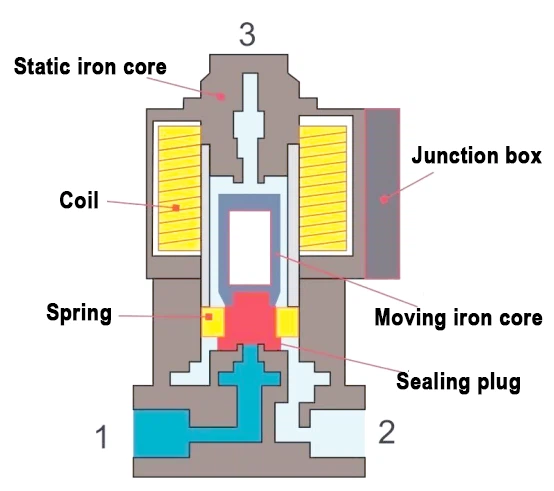
Figure 1 shows a simple cross-sectional view of a 3/2 (three-way two-position) direct-acting solenoid valve (normally open type) and its working principle. When the coil is energized, the static iron core will generate electromagnetic force, and this force will push the valve core to move upward. As the valve core rises, the gasket is lifted, thus connecting ports 1 and 2 while disconnecting ports 2 and 3. At this point, the valve is in the intake state and can control the movement of the cylinder. Once the power is cut off, the valve core will rely on the restoring force of the spring to return to its original state, that is, ports 1 and 2 are disconnected while ports 2 and 3 are connected. In this way, the valve is in the exhaust state.
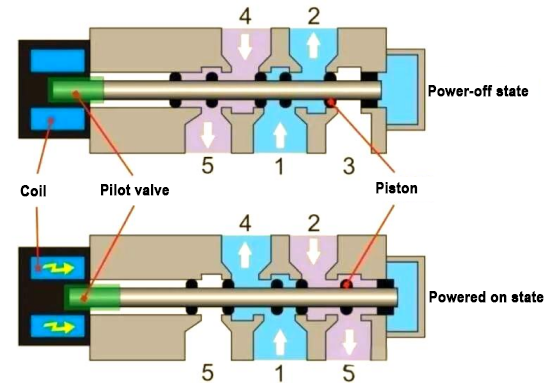
Figure 2 shows a simple cross-sectional view of the 5/2 (five-way two-position) direct-acting solenoid valve (normally open type) and its working principle. In the initial state, air intake occurs through ports 1 and 2, while exhaust is carried out through ports 4 and 5. When the coil is energized, the static iron core generates electromagnetic force. This force will drive the pilot valve to operate, and then compressed air will enter the pilot piston of the valve through the air path, causing the piston to start. In the middle of the piston, the sealing circular surface opens the channel. At this time, air takes in from ports 1 and 4, while air is discharged from ports 2 and 3. Once the power is cut off, the pilot valve will rely on the restoring force of the spring to return to its original state.
Next, let's talk about the function of the solenoid valve. The function of an electromagnetic valve is represented by two numbers: M and N, which is called an M-path N-position electromagnetic valve. Among them, "N position" represents the switching position of the directional control valve, that is, the state of the valve. The number of valve positions is the value of N. For instance, a two-position valve has two position options, that is, it has two states. The three-position valve has three position options, that is, there are three different states. The "M path" indicates the number of external interfaces of the valve, including the air inlet, air outlet and exhaust port. The number of pathways is the value of M.
Take the valve in Figure 1 as an example. It is a 3/2 direct-acting solenoid valve, that is, the valve has two positions, namely "on" and "off" states. At the same time, it has three air ports: 1 is the air inlet, 2 is the air outlet, and 3 is the exhaust port.
Analysis of the solenoid valve airway
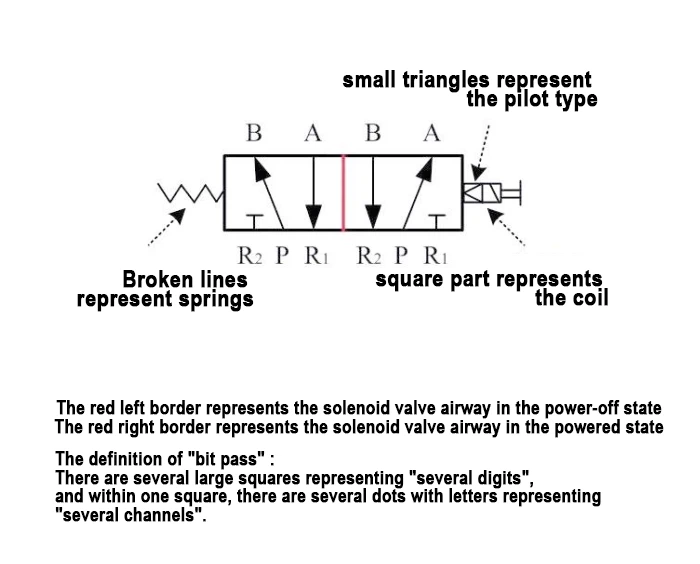
At the left end of the gas path diagram, the symbol on the far left usually represents the bottom spring. The middle part is the valve body, which contains the key information for determining the type of solenoid valve. For instance, the two boxes in the figure indicate that this is A two-position solenoid valve, while A/B/R/P/S represent the hole positions of the valve body, that is, the five-way valve. Therefore, this solenoid valve is a two-position five-way solenoid valve. Similarly, we can determine the number of bits and the number of passes of the solenoid valve by the number of holes and the number of boxes.
In addition, the gas path diagram also shows the gas path operation routes when power is off and when power is on. When power is cut off, the air path enters through hole P, acts on the actuator through hole A, then passes through hole B, and is finally discharged from Hole S, while Hole R remains closed. When powered on, the air path also enters from hole P, but at this time, air is discharged from hole B, acting on the actuator and passing through hole A, and finally being discharged from hole R, while Hole S is closed.
The right part of Figure 3 generally represents coils or pilot small valves, which play an important role in the operation of solenoid valves. By interpreting these airway diagrams, we can gain a deeper understanding of the working principle of the solenoid valve and the operation of the airway under different conditions.
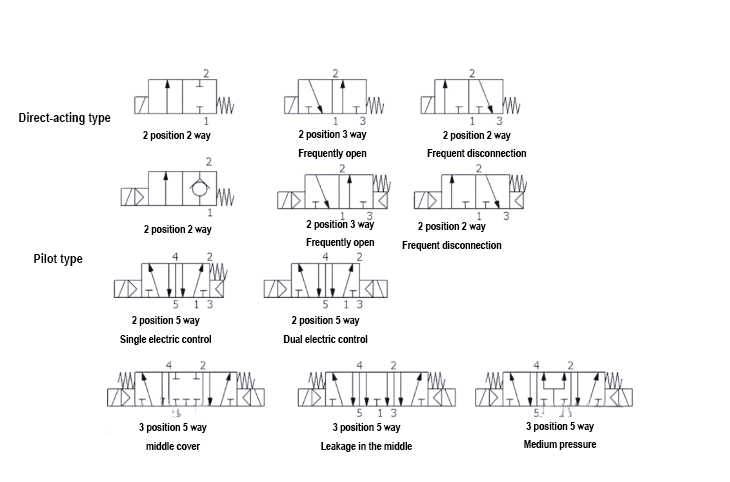
Figure 4 shows the electrical schematic diagram of the pneumatic solenoid valve. The electrical schematic diagram is the key to understanding the working principle of an electromagnetic valve. It clearly depicts the coil, contacts, and the connection relationship with other electrical components. By observing the electrical schematic diagram, we can gain a deeper understanding of the electrical changes of the solenoid valve when it is powered on and off, thereby better grasping its working characteristics.
Iv. Selection of Single-Control Solenoid Valves and Double-Control Solenoid Valves
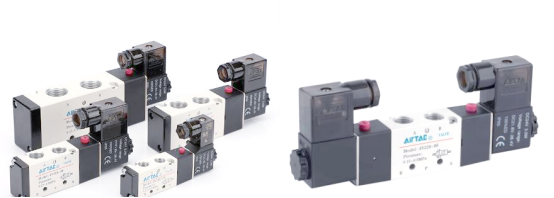
The single electrically controlled solenoid valve, as its name suggests, is equipped with only one coil. When powered on, it will change and enter another state. When the power is cut off, it will automatically return to the original state. This working principle is shown in Figure 5. In contrast, the double electro-controlled solenoid valve is equipped with two coils. By controlling the energized states of different coils, it can achieve multiple switches and still maintain its previous state after power-off, as shown in Figure 6. This functional difference directly determines their different choices in practical applications.
Figures 5 and 6 demonstrate the working principles of single-control solenoid valves and double-control solenoid valves. When making a selection, if the reversing time of the valve is relatively short, a single-control solenoid valve is sufficient to handle it. However, if the commutation time is long, the coil needs to be continuously powered on, which may cause the coil to heat up due to prolonged power-on and even burn out. To avoid this situation, a double-control valve can be selected. In addition, if the reset function needs to be achieved after power failure, a single electrically controlled solenoid valve is more suitable. If it is necessary to maintain the current state after power failure, a double-control solenoid valve is more suitable.
V. Differences and Applications between Pilot-operated Solenoid Valves and Direct-Acting Solenoid Valves
Among the types of solenoid valves, pilot-operated and direct-acting are two common types. They differ in working principles and application scenarios. Pilot-operated solenoid valves switch between gas and liquid through pilot holes, while direct-acting solenoid valves rely on pressure differences to control the movement of the valve core. This difference makes the two types of solenoid valves each have their own advantages when responding to different industrial demands. For instance, in some situations that require rapid response and high sensitivity, direct-acting solenoid valves may be more suitable. In situations where fine control and lower energy consumption are required, pilot-operated solenoid valves may have an edge.
The structural design of direct-acting solenoid valves is relatively simple. Their working principle mainly relies on electromagnetic force to directly drive the valve core to act. However, this design also has two major shortcomings. Firstly, due to the large demand for electromagnetic force, the volume of the electromagnet coil increases accordingly, which in turn leads to higher energy consumption. Secondly, direct-acting solenoid valves are relatively sensitive to pressure. When the pressure exceeds a certain limit (usually over 0.7MPA), many direct-acting solenoid valves cannot function properly. This is mainly due to the excessively high pressure acting on the valve core, making it difficult for the electromagnetic force to drive the valve core to operate. Despite this, direct-acting solenoid valves also have their advantages: simple structure, affordable price and low failure rate.
2. The pilot-operated solenoid valve is ingeniously designed. It abandons the traditional electromagnetic force drive and instead uses air pressure to drive the valve core to act. For solenoid valves with a diameter exceeding 4mm, they are usually composed of a pilot valve and a main valve. After the solenoid valve is powered on, the pilot valve will open and control the opening of the main valve through its output signal. It is worth noting that the main valve is actually a pneumatic control valve, and its operation requires the coordinated action of two air sources: one is the main valve air source, and the other is the pilot valve air source.
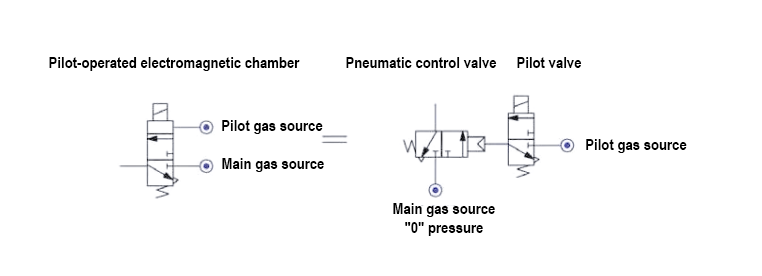
If the main air source supplies air to the pilot valve through the internal air passage of the solenoid valve, this design is called an internal pilot type. If the pilot valve is supplied with gas from a source independent of the main gas source, it is called an external pilot type. In Figure 8, the left side shows an example of an external pilot-operated solenoid valve, while the right side shows an example of an internal pilot-operated solenoid valve.
The physical comparison between the internal lead and the external lead is shown in the following figure.
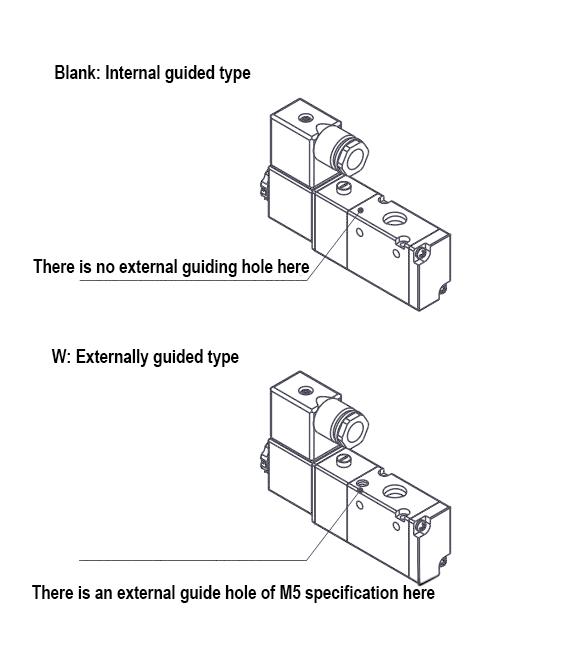
These two types of solenoid valves, namely internal pilot and external pilot, often coexist in the same system. Usually, the internal pilot can already meet the needs of most occasions. However, in some specific circumstances, external leadership becomes even more necessary. For instance, when the gas source pressure of the main valve fluctuates and may drop below 0.2MPA, or when it is in a vacuum environment, since the gas source of the pilot valve cannot be shared with that of the main valve, otherwise it may lead to the main valve being unable to open. At this point, an independent air source with a pressure exceeding 0.2MPA is required to power the pilot valve. In addition, when the pressure difference between the air inlet and outlet is significant, or when the main airway pressure exceeds 1MPA, the internal pilot may need to increase the structural volume by directly loading the airway pressure onto the valve core. The external pilot solves the problem by directly introducing one gas channel into the pilot port without the need to add an electromagnetic valve; only an air pipe needs to be added.
In conclusion, pilot-operated solenoid valves have the advantages of small electromagnetic heads and low power consumption. It is aesthetically pleasing and saves installation space. Meanwhile, it generates less heat and has a remarkable energy-saving effect. More importantly, due to the low heat generation, the coil is less likely to burn out and can be powered on for a long time. This is particularly important in practical applications. For instance, the power of some solenoid valves from SMC has been reduced to as low as 0.1W, enabling continuous power supply without overheating. The power range of direct-acting solenoid valves is 4-20W, with a relatively short power-on time. Moreover, frequent power-on poses a risk of burnout. Therefore, in situations where power supply for long periods or at high frequencies is required, pilot-operated solenoid valves become the preferred choice. In fact, most of the commonly used solenoid valves nowadays have adopted pilot-operated design. Among the solenoid valves that only allow liquid to pass through, direct-acting ones still account for a certain proportion. This is mainly due to the fact that impurities in the fluid may clog the narrow pilot valve channels.
Next, we will delve into the three types of three-position five-way solenoid valves: middle-sealed, middle-vented, and medium-pressure, as well as their applications. This type of solenoid valve uses double electric control coils. When neither of the two electromagnets is energized, the valve core will be in the middle position under the balanced push of the springs on both sides. At this point, the on-off state of the gas path in the solenoid valve will determine its specific type - middle sealing, middle venting or medium pressure. We will analyze the principles and application scenarios of these three types one by one.
1.Analysis of the middle seal state: When neither of the two coils is energized, the pressure in the front and rear chambers of the cylinder will remain at the state after the coils are de-energized and will not change. At the same time, both the air intake and exhaust ports are closed. However, maintaining this state for a long time may gradually cause it to lose balance due to minor leaks. The schematic diagram is shown in (Figure 10).
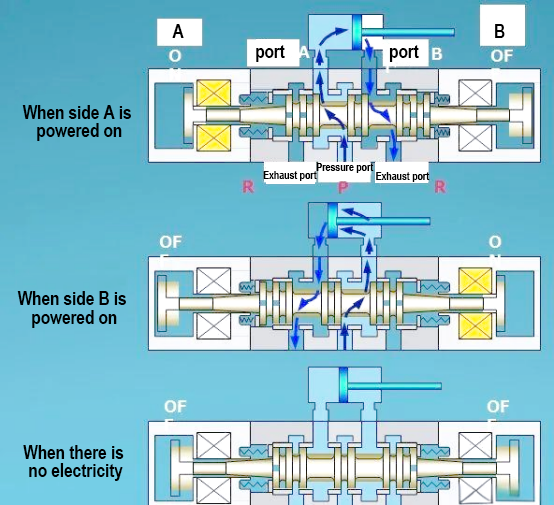
Due to the compressibility of gas and the fact that pneumatic components such as cylinders, valves and gas pipe joints cannot be completely leak-free, the cylinder cannot be stably maintained at the intermediate stop position for a long time. This balanced state will gradually be lost over time, resulting in a decrease in the positioning accuracy of the cylinder. However, for those working conditions where the positioning accuracy of the cylinder is not highly demanded and the stopover time is relatively short, the middle-sealed cylinder can still be considered for use.
2. Medium discharge method: When neither of the two coils is energized, there is no pressure in the front and rear chambers of the cylinder, and the air intake port remains closed at the same time. At this point, the pressure in the front and rear chambers of the cylinder will be discharged through the two exhaust ports of the solenoid valve. Its working principle can be referred to in Figure 11.
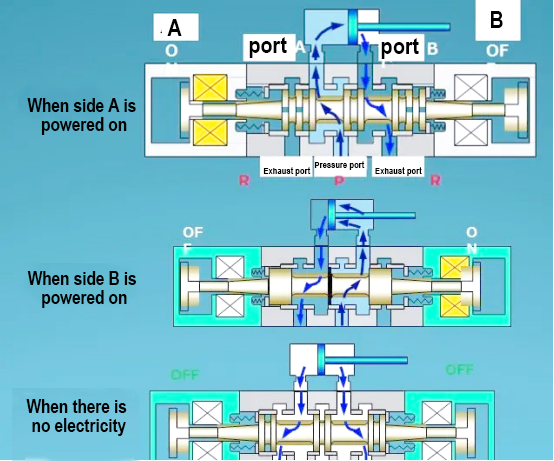
Compared with the middle-sealed valve, the middle-discharge circuit design can provide a longer mid-stop time. In scenarios where the cylinder needs to move vertically, the mid-stop time is relatively long, but the positioning accuracy requirement is not very strict, the mid-release circuit is a choice worth considering.
3. Medium pressure state: When neither of the two coils is energized, the pressure in the front and rear chambers of the cylinder will remain at the state when the previous coil is de-energized, and continuous pressure will be applied to ensure that the pressure in the front and rear chambers of the cylinder is consistent with that at the intake end. At this point, the air intake is open while the exhaust is closed. The working principle is shown in Figure 12.

If the cylinder is not subjected to an axial external load force, the piston will remain in a balanced state and thus precisely stay at any position during the stroke. The characteristics of this circuit require that the cylinder must be installed horizontally. Therefore, in working conditions where high-precision positioning is required and there is no axial external load force, it is recommended to use a medium-pressure valve in combination with a double piston rod cylinder.


