

Detailed Installation and Wiring of Double-Pneumatic Cylinder: A Practical Guide from Beginner to Expert
Correct installation and wiring are the last crucial steps to ensure that the double-Pneumatic cylinder can fully leverage its advantages of high precision and high rigidity. Improper installation may lead to premature wear, reduced accuracy, and even catastrophic failures. This article will detail the installation process, wiring methods and core precautions step by step to ensure that you can complete the debugging work correctly and efficiently.
I. Installation Steps and Core Specifications
1. Preparations before installation
Status confirmation: Ensure that the piston rod is fully retracted. This is the most important initial state, which is convenient for positioning and adjustment.
Inspect the parts: Check the appearance of the Pneumatic cylinder for any transportation damage, and clean the installation surface and the Pneumatic cylinder base to ensure there are no impurities.
2. Installation base surface requirements (top priority!)"
The double-pneumatic cylinder has extremely high requirements for the flatness of the installation base surface, which is the foundation for ensuring that it does not generate internal stress and operates smoothly.
Flatness: The flatness of the base that fits with the Pneumatic cylinder installation surface must be less than 0.05mm. Exceeding this range will cause the Pneumatic cylinder block to be forcibly twisted, generating huge internal stress, accelerating the wear of seals, and leading to action stalling, crawling, and even damage.
Installation specification: Use bolts with the recommended torque and lock them step by step in the diagonal sequence to ensure that the Pneumatic cylinder base is evenly attached to the installation surface and to prevent any loosening or seesaw phenomenon.
3. Load connection
Connect the load equipment (such as grippers, suction cups, etc.) to the output end plate of the Pneumatic cylinder (i.e., the common connection plate of the two piston rods).
Make sure the connection is firm, and the centre of gravity of the load is as aligned as possible with the axis of the Pneumatic cylinder to minimise the additional overturning moment.
Ii. Gas Line Wiring Guide
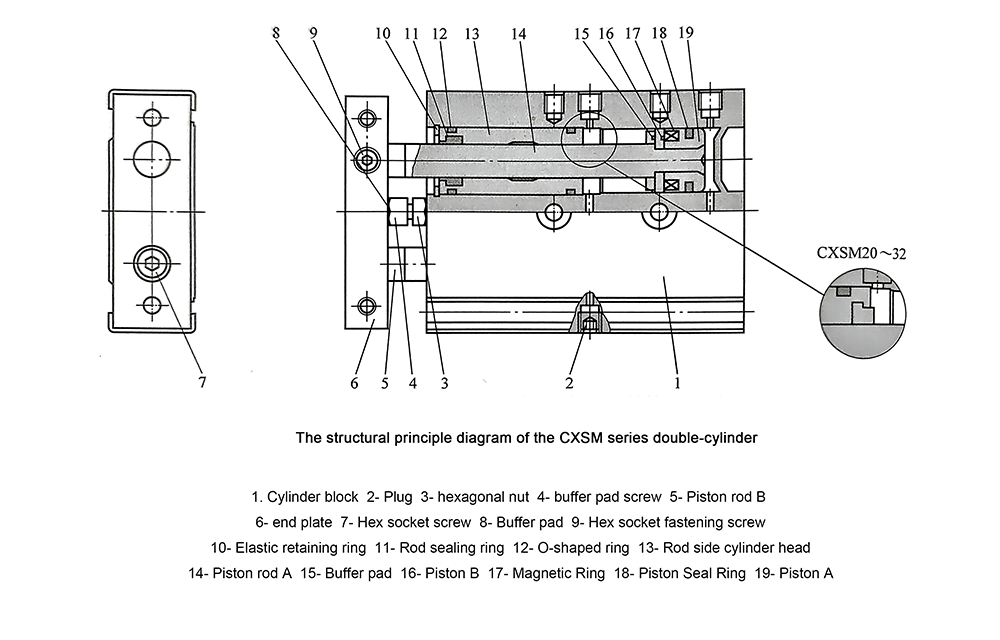
The double-pneumatic cylinder has multiple air ports, and the wiring method depends on your control requirements.
1. Airport identification
Generally, a double-pneumatic cylinder has two air intakes (or one intake and one exhaust), located on both sides of the Pneumatic cylinder block. Please refer to the product sample or the markings on the Pneumatic cylinder (such as "A" port and "B" port).
2. Standard double-acting connection method (most commonly used)
Method: Connect the two air ports respectively to the two output ports of a five-way (5/2) or a four-way (4/2) solenoid valve through a speed-regulating joint (or directly).
Principle: By controlling the alternating entry of compressed air into the chambers on both sides of the Pneumatic cylinder through a reversing valve, the extension and retraction of the piston rod are achieved.
Suggestion: Install a speed control joint (one-way throttle valve) on each gas path to precisely regulate the extension and retraction speeds of the Pneumatic cylinder, ensuring smooth movement.
3. Single-acting connection method (Special cases)
Method: If only one direction of drive is required, one air port can be blocked (using the provided plug), and the other air port can be connected to a three-way (3/2) solenoid valve. Return by relying on a spring or external force.
Note: This connection method will waste half of the output capacity of the double-Pneumatic cylinder. It is not recommended unless necessary.
Iii. Electrical Wiring Guide - Magnetic Switch
Magnetic switches are used to detect the position of the piston rod and provide feedback signals to the PLC or controller.
Install the magnetic switch
Position: Embed the magnetic switch into the specially designed T-slot on the Pneumatic cylinder block. This design saves space and is aesthetically pleasing.
Adjustment: After connecting the vent line and the circuit, manually make the Pneumatic cylinder reciprocate. Observe the LED indicator light on the magnetic switch and fix and lock it at the position where it lights up. Its position can be fine-tuned to precisely control the stop point.
2. Circuit connection
Type: Usually NPN (drain type) or PNP (source type), three-wire (power +, power -, signal output) or two-wire.
Wiring
Brown wire: Connect to the positive terminal of the DC power supply (+24VDC).
Blue line (Blue): Connect to the negative terminal of the DC power supply (0VDC).
Black line: Signal output line, connected to the input point of the PLC (such as X0) or the signal terminal of the controller.
Important: The load (such as Pa LC) must be connected in series in the magnetic switch circuit, and it is necessary to ensure that the power supply voltage matches the rated voltage of the switch. Usually, a current-limiting resistor needs to be added to the circuit (if the PLC input point is not a resistive type) to prevent the switch from being burned out.
Iv. Safety Precautions and Debugging Taboos
Do not disassemble the buffer screws: Never remove the buffer screws at both ends of the Pneumatic cylinder block for adjusting the stroke. They are precisely tuned. Disassembling them without authorisation will lead to performance loss and airway disorder. Fine-tuning of the stroke should be achieved through mechanical stops or external mechanisms.
Do not use beyond the rated stroke: Do not use external mechanical devices to force the Pneumatic cylinder to stop at a position beyond its rated stroke, as this will seriously damage the internal structure.
The first debugging should be slow: When ventilating for the first time, first adjust the speed control valve to a low speed state, perform a jog operation, and observe whether the Pneumatic cylinder runs smoothly without any abnormal noise. Then gradually increase the speed.
Good lubrication and filtration: Ensuring the quality of the air source, using a three-piece set (filter, pressure reducing valve, oil mist lubricator) to provide clean, dry air containing trace amounts of lubricating oil is the key to extending the service life of the Pneumatic cylinder.

Double Pneumatic cylinder CXSLSeries
This model demonstrates an outstanding user experience in terms of installation and wiring
Convenient installation: Offers multiple installation options. It can be conveniently fixed on the bottom or side and easily integrated into your device.
Integrated T-slot: The Pneumatic cylinder body is designed with a standard T-slot, which facilitates the installation, adjustment and fixation of magnetic switches, and the wiring is neat and beautiful.
High-rigidity structure: Its sturdy body ensures that after being installed strictly in accordance with the specifications, it can maintain extremely high installation accuracy for a long time and prevent relaxation.
Ready-to-use: The product quality is reliable and adheres to standard specifications, significantly reducing the complexity and uncertainty of installation and commissioning.
Conclusion: Choosing CXSLSeries means that you are not only selecting a high-performance Pneumatic cylinder, but also choosing the convenience of installation and the reliability of operation. By following this guide, you will be able to fully leverage its powerful performance of being thin and highly precise in guidance, adding a strong and accurate "executor" to your automated equipment.
Above is the Detailed Installation and Wiring of Double-Pneumatic Cylinder: A Practical Guide from Beginner to Expert content. To learn more related information, visit https://www.joosungauto.com/.


